
Bucktail is the tail hair from a white-tailed deer, and it has been a go-to jig material for a long time. The hairs are hollow and fairly stiff at the base, then taper to a fine tip. That shape matters. When you pause the jig, the hair flares out and breathes. When you pull it, the hair sweeps back and slims down like a small baitfish darting away.
Trout often key on small baitfish, sculpins, and leeches, so that pulse is what you want. Bucktail doesn't need much help to look alive in a slow pool or a soft seam. Even the tiniest twitch of your rod tip moves the fibers. Synthetic skirts can look great, but many of them stay stiff or clump when you hold the jig still. Bucktail keeps its shape and keeps moving.
Another reason to tie with it is the range of colors and the way the hair takes dye. Natural white, tan, and olive-brown fit most trout water, especially clear streams where fish get a good look at your jig. Brighter colors like chartreuse or pink can help in stained water or low light. Buying a few dyed patches gives you plenty of options without much cost.
Bucktail also floats a bit in the water compared to heavy materials, so the jig hangs level and doesn't nosedive as fast on the fall. That slower drop is useful when trout hold just off the bottom. You can match the hair length to the head size as you tie. A short, sparse tuft suits a small jig for picky fish, while a fuller dressing gives more bulk when trout are chasing bigger meals.
If you want to see how a finished bucktail jig looks before you tie your own, the 3pcs Bucktail Jig Heads for Striper, Fluke, Bass and Trout pair a bucktail skirt with crystal flash and 3D eyes. They make a handy reference for proportions and color combos. If you'd like a different natural material to compare, the 5 Pack Hand-Tied Natural Rabbit Fur Jigs 1/8 oz use fur to imitate baitfish and sculpins.

3pcs Bucktail Jig Heads for Striper, Fluke, Bass and Trout
A three-pack of bucktail jig heads with crystal flash and 3D eyes for inshore and freshwater fishing.
Product information
Product Review Score
4.66 out of 5 stars
(118 reviews)Product links
Gathering Your Hooks, Thread, and Bucktail
A bucktail jig needs only a few parts, and most of them cost very little. You need a jig head, a spool of thread, a bucktail patch, and a pair of sharp scissors. The jig head is the part to think hardest about, because it sets your weight and your hook size. For small trout water, pick a light head and a hook sized to match the bait you want to imitate. The Mix Size Jig Heads for Bass Trout Fishing let you try several sizes before you commit to one.
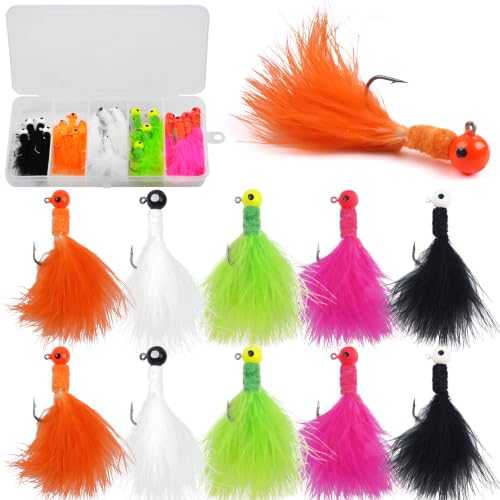
Mix Size Jig Heads for Bass Trout Fishing
High-quality jig heads for bass and trout fishing in various sizes
Product information
Product Review Score
4.11 out of 5 stars
(156 reviews)Product links
Look at the hook before you buy a batch. A jig head with a collar or a small barb on the shank gives your thread something to bite into, so the hair doesn't spin or slide. A smooth shank works, but you'll need a few extra wraps and a drop of head cement. Check the hook eye too. Make sure it's clear of paint, since a blob of paint can block your knot or tippet. If your local rules require barbless hooks or single hooks on certain waters, check the regulations before you tie a big batch. You can pinch the barb down with pliers after you tie.
For thread, choose something strong and fine. Many tiers use a 6/0 or 8/0 thread for small jigs, and a heavier size works fine for bigger heads that hold more hair. Pick a color that blends with your bucktail. White or tan thread disappears under natural hair, and a bright thread like red or chartreuse makes a head that stands out. Buy a bobbin too if you don't have one. It holds the spool, keeps tension steady, and keeps your hands free.
When you choose bucktail, hold the patch up and check the hair. Long, straight fibers are easier to work with than short, curly ones. Natural colors are a good place to start. Keep a small comb or an old toothbrush handy to pull out the short, fuzzy underfur before you tie. A pair of hair stackers helps line up the tips, but you can do without one when you start.
Set up your bench with safety in mind. Scissors and hook points are sharp, so cut away from your fingers and keep the hook point turned away from you. A hook held in a vise is safer than one held in your hand. Good light and a clear workspace also make it easier to spot a stray hook before it finds your thumb.
Tying the Jig Step by Step
Clamp the jig head in your vise by the bend, with the hook point up and the eye pointing forward. Start your thread just behind the eye and wrap back over the collar or shank for a dozen or so turns, then back toward the eye. That gives the hair a rough base to grip. If the shank is smooth, add a few extra wraps now, since bare paint lets hair slip.
Cut a small clump of bucktail from the patch, close to the skin, and pull out the short underfur. Stack the tips. Measure the clump against the jig so the tips reach up to the end of the hook bend, or a little past it for a longer profile. Cut the butt ends so they sit just behind the eye. Hold the clump on top of the shank and make two loose wraps over it, then pull the thread down snug. The hair will flare around the shank. That is normal and it is what you want.
Tie in the hair with a few tight wraps, but go easy on the amount. Trout jigs look best sparse, and you can always add a second small clump on the underside or sides. Use less than seems right. Trim the butt ends at a slant, then wrap over the stubs to make a smooth, tapered head. Finish with a whip finish, or a few half hitches if you don't have a whip finish tool. Cut the thread, then let the cement you applied dry fully before you handle the jig. Keep your hair clumps and thread away from the hook point.
For a first batch, tie three of the same jig in white, tan, and olive, so you can compare them on the water. If you want a bit of flash, tie in two or three strands of flash material on each side before you trim the head. Check each jig by pulling the hair gently. If it slides, add wraps. Wear glasses if you trim close to your face.
Fishing Your Bucktail Jigs for Trout
A bucktail jig fishes best on light spinning gear. A 1/16 or 1/8 ounce jig on a rod rated for light lures and a few pounds of mono or fluorocarbon gives you a good feel for the fall and the swing. Tie on with a loop knot, like a Rapala-style non-slip loop, so the jig can swing freely. A tight clinch knot on the eye pins the head and kills some of the motion.

Ultra Light Spinning Fishing Rod 5ft 2pc EVA Handle
A light 5 foot two piece spinning rod with an EVA grip, built for small trout streams and easy casting.
Product information
Our review: 4.0 out of 5
Product links
Start with the cast-and-swing in a stream. Cast across and slightly upstream, let the jig sink for a second or two, then lift the rod tip slowly as the current carries it down. Keep a little tension so you feel the tick of the bottom, but don't drag it along the rocks. Trout often hit right as the jig swings out and starts to rise at the end of the drift. Hold on that moment for a beat before you reel in. Strikes can feel like a soft tap or just a heavy pause, so lift the rod when anything feels different.
In lakes and slow pools, try a hop-and-pause retrieve. Let the jig sink toward the bottom, give the rod tip a short lift, then let it fall on a slack-ish line while you watch the line for a jump or a sideways twitch. Slow steady reeling works too, especially near drop-offs or weed edges where trout cruise. Match your pace to the water. Fish tend to follow a slower jig in cold water, and a quicker pull can trigger them when they are active. Switch colors before you switch everything else. If white gets ignored, try olive or a brighter dyed pattern.
Check your jig after every few fish or snags. Bucktail can mat down over time, so run your fingers through it and trim any ragged tips. If the hair starts sliding on the shank, retire that jig and tie a fresh one. When you unhook a fish, wet your hands first and keep the fish in the water as much as you can. Wear polarized glasses to protect your eyes on windy casting days.


